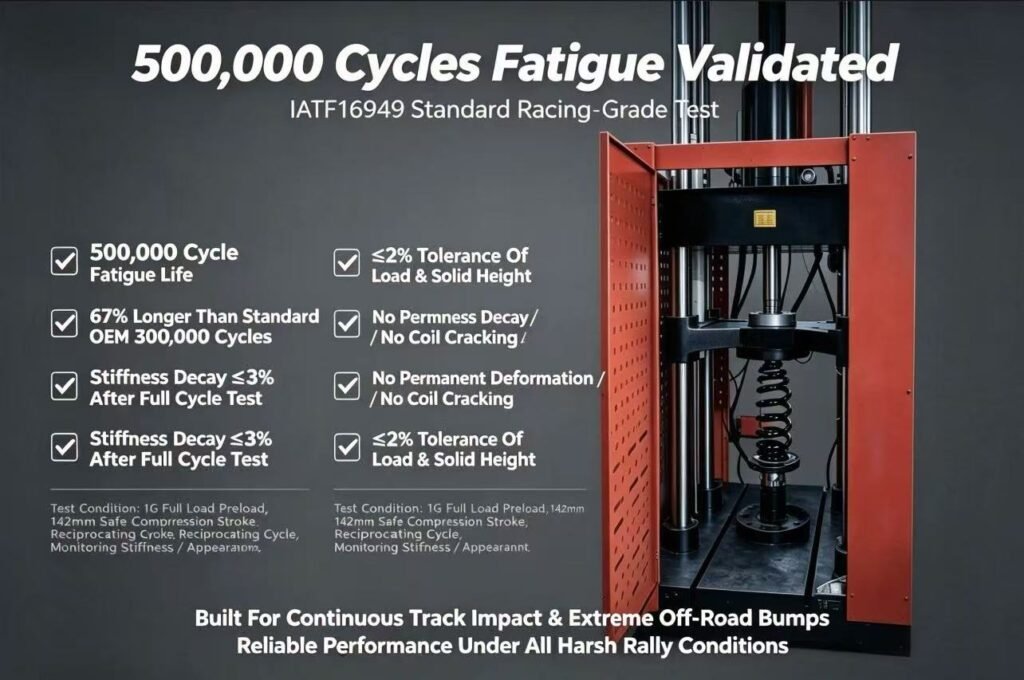
- Equipment Description: The large-capacity four-column hydraulic fatigue testing machine is designed for heavy-duty competitive springs with large wire diameters; it simulates full-load conditions and continuous impact scenarios on race tracks, automatically cycling through compression cycles while recording load, deformation, and cycle counts. Testing complies with IATF 16949 standards, with the springs subjected to 500,000 fatigue cycles, during which failure modes such as stiffness degradation, coil cracking, and paint peeling are monitored throughout.
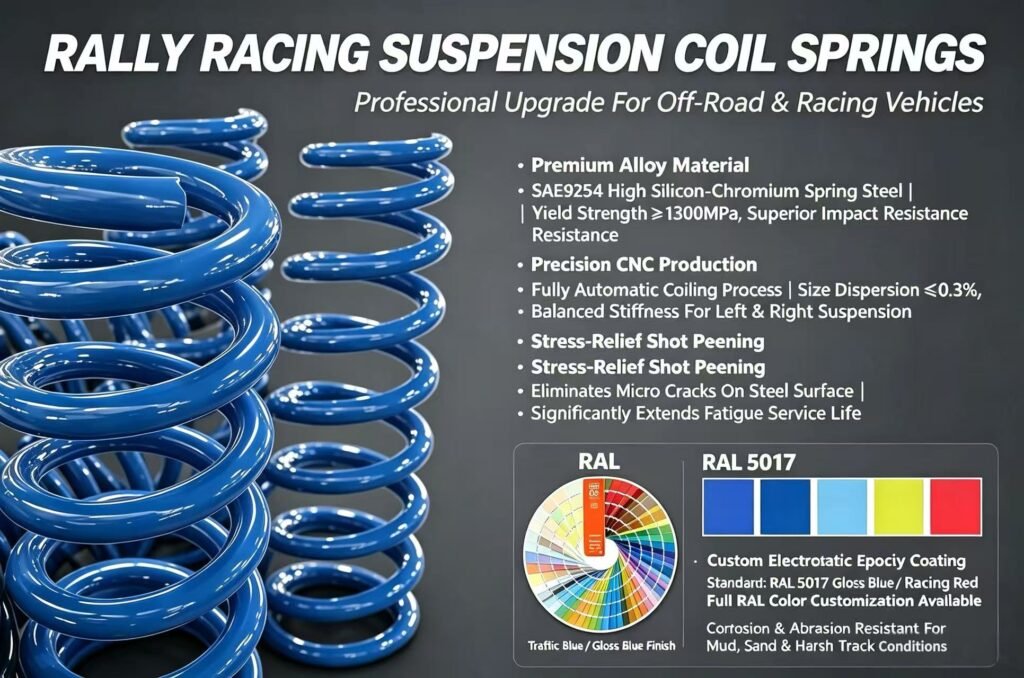
II. Finishing Surface Spraying Inspection (See Figures 2 and 3) Process and Appearance: The spring steel is made of SAE9254 high-silicon chromium alloy, subjected to quenching and tempering followed by shot blasting for stress relief; the finished products are available in two custom electrostatic epoxy spray coatings: RAL5017 glossy blue and competitive red. The coating is uniform without scratches or surface defects, with strong adhesion; both end support rings are smooth and free of burrs, and the spacing between spring coils is precise without distortion.
Quality inspection conclusion: The sampled products meet all requirements regarding appearance, coating quality, and dimensions, fulfilling the corrosion-resistant and wear-resistant specifications for competition components.
III. Competitive-level Fatigue Testing Standards: The test is conducted under a static load of 1 G applied to the vehicle as the pre-load condition, with reciprocating cycles performed over the 142 mm safety compression stroke specified in the drawings; the competitive spring must withstand 500,000 fatigue cycles (compared to only 300,000 cycles for civilian factory versions, representing a 67% improvement in fatigue life). Stiffness, length, paint condition, and coil state are recorded every 50,000 cycles.
Quality Requirements: After 500,000 cycles, stiffness attenuation shall be ≤3%, with no permanent deformation; the coil shall exhibit no cracks or pitting corrosion; the paint surface shall show only minor spot wear; the compression load and ultimate height shall deviate from the theoretical values specified in the drawings by ≤2%.
IV. Core Process Advantages of the Product Material: SAE 9254 high-strength alloy steel with a yield strength ≥1300 MPa, offering impact resistance and durability under continuous vibration; Shot blasting process: eliminates micro-stress cracks in the steel, significantly extending fatigue service life; Custom coating: electrostatic epoxy spraying resistant to sand and mud corrosion, available in custom RAL colors upon request; Precision manufacturing: CNC-controlled fully automated spring rolling equipment ensuring dimensional accuracy ≤0.3% and uniform stiffness across left and right springs, guaranteeing optimal vehicle suspension balance.