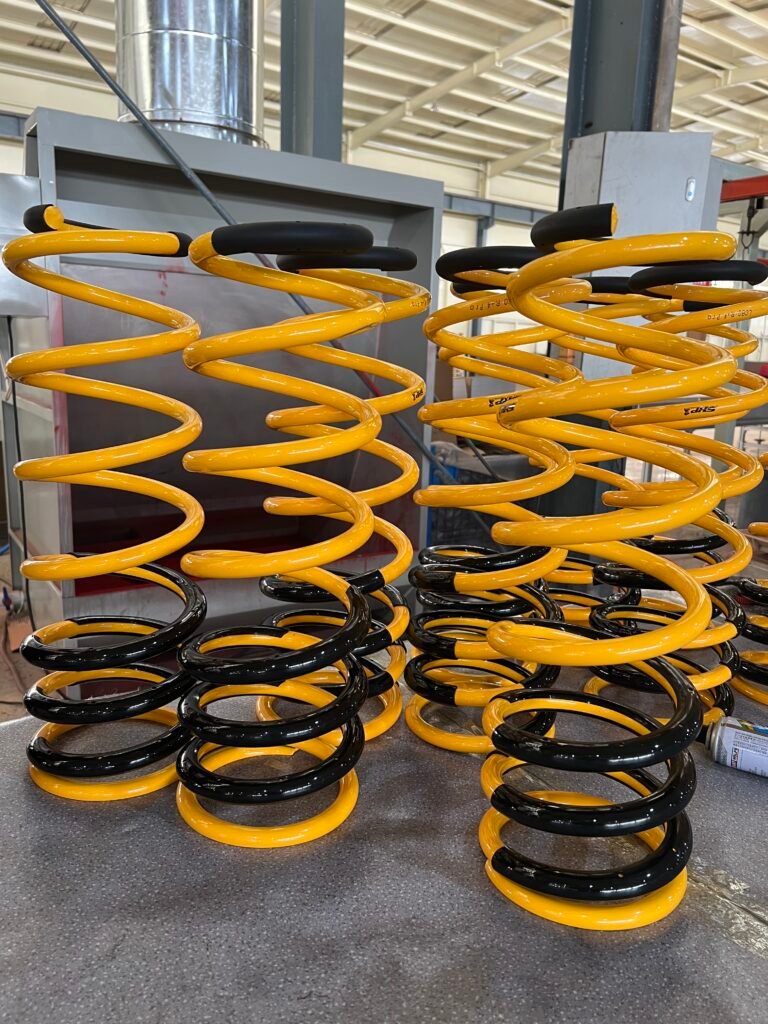

When talking about off-road upgrades, enthusiasts often focus on eye-catching parts like shock absorbers, tires and wheels. Many tuners fall into a common misconception: high-performance shocks alone can drastically improve off-road capability.
However, field tests and chassis load research consistently prove that coil springs form the mechanical foundation of the entire suspension system.
Shock absorbers control vibration damping. Coil springs carry static vehicle weight and dynamic impact loads. They determine ride height, suspension travel and center of gravity distribution. Poorly selected springs will prevent premium shocks from performing at their best. Worse, weak springs can lead to sagging, side-loading fracture and broken chassis geometry, creating serious safety risks.
For hard-core off-roading, overland expeditions, heavy-load camping, desert runs and rock crawling, the material, hot-forming process and stress-relief design of coil springs directly decide the reliability of your whole upgrade kit.
As an export-focused coil spring manufacturer, we combine years of OEM experience and real-world test data from global off-road markets to break down the engineering logic behind off-road coil springs.
1. Core Differences Between Off-Road Coil Springs & OEM Passenger Car Springs
Factory vehicle springs are engineered primarily for paved roads. They balance comfort and cost with a small load margin. Once owners add lift kits, bull bars, auxiliary fuel tanks, roof racks and camping gear, sprung mass rises sharply. OEM springs will quickly compress and sag.
Off-road performance coil springs follow a completely different engineering philosophy:
Load Rating Calibration
Making the wire thicker does not automatically create a heavy-duty spring. Spring rate (k-value) must match the modified sprung weight of the vehicle. The ideal k-value varies greatly for light overland travel, heavy camping and rock crawling.
- Too low spring rate: spring sag, insufficient suspension travel.
- Too high spring rate: stiff ride, poor tire contact with uneven terrain and reduced off-road traction.
High-quality off-road springs are split into two main designs:
- Linear Rate Springs: Constant stiffness. Preferred for rock crawling and heavy off-road use for direct, predictable feedback.
- Progressive Rate Springs: Softer under light load, stiffening automatically under heavy weight. Ideal for long-distance overland expeditions.
Stress Control Equals Long-Term Durability
Off-road suspension faces repeated cyclic impact loads. Stress concentration is the #1 cause of spring breakage. Key processes including hot coiling of spring steel bar, end grinding, shot peening and stress-relief tempering all affect fatigue life.
Many low-cost aftermarket springs only increase wire diameter while skipping stress-relief treatments. They look robust at first, but cracks easily form at spring ends after repeated off-road impacts.
Lift Height ≠ Simply Longer Spring Length
A widespread myth: to achieve a 2-inch lift, just add 2 inches to spring length.
Lengthening springs alters suspension geometry, kingpin angles and steering behavior. Professional off-road coil springs are engineered to match vehicle load while maintaining correct chassis geometry at the target lift height, preventing abnormal tire wear and steering issues.
2. Coil Spring Selection by Off-Road Application Scenarios
Rock Crawling
Requirements: Long suspension travel, stable body control and precise support. Linear rate hot-coiled springs are recommended. Springs must withstand intermittent heavy impacts with excellent anti-fatigue performance, paired with long-travel shocks. Design priorities: minimize side load and prevent spring seat separation.
Desert High-Speed Off-Road
Suspension cycles rapidly over continuous rough terrain. Springs need stable support without excessive harshness. Spring steel must maintain good toughness under cyclic loading and resist performance degradation at high working temperatures.
Overland & Heavy-Duty Camping
Vehicles carry extra gear, raising sprung weight. Progressive rate coil springs are the popular choice. They retain comfort when lightly loaded and deliver extra support once water tanks, spare parts and camping gear are mounted. The design avoids nose or tail sag and protects shocks and chassis components.
A common industry pain point: many generic aftermarket springs only advertise lift height without listing rated load capacity. Shops and customers discover sagging only after full installation, leading to costly rework and damaged reputation. This explains why global off-road brands increasingly partner with dedicated spring factories for custom development.
3. Manufacturing: Critical Processes for Premium Off-Road Coil Springs
As an export manufacturer specialized in coil springs, our R&D and production are optimized for cyclic off-road impact loads:
- Premium Alloy Spring Steel: High-purity raw material with high tensile strength and impact toughness to reduce fracture risks caused by material impurities.
- Hot Coiling: Used for large wire diameter off-road springs to achieve uniform forming and avoid residual stress from cold coiling.
- Shot Peening: Creates a compressive stress layer on the spring surface to extend fatigue life and slow crack propagation under impact.
- Stress-Relief Tempering: Removes residual stress generated during coiling to prevent height loss (spring sag) in service.
- Anti-Corrosion Coating: Off-road environments expose parts to mud, salt and rock chipping. Powder coating options protect springs against rust.
- Load & Fatigue Testing: Every batch undergoes load verification and fatigue testing. Spring rate and free height consistency are fully traceable to meet strict quality requirements for global off-road markets.
Budget competitors often cut costs by removing shot peening and tempering steps. No defects may show immediately after installation, but performance gaps emerge after thousands of kilometers of rough terrain.
4. Custom Development: The Future of the Off-Road Aftermarket
Global off-road markets are shifting from ready-made generic springs toward model & load-specific custom development.
Off-road brands and tuners no longer only source standard off-the-shelf springs. They require custom k-value springs built for specific vehicle models plus full upgrade packages including front bumpers, auxiliary tanks and roof storage.
We support OEM & ODM custom projects. Based on customer inputs including sprung mass, target lift height and terrain type (rock, desert, overland), our team completes spring mechanical calculation, wire diameter, coil diameter and coil count design, delivers samples for testing and handles mass export orders. Both small-batch prototype runs and large-volume production are available.
Closing Thoughts
Coil springs act as the skeleton of the suspension system. Even top-tier shock absorbers can only operate within the mechanical limits set by springs. Well-engineered coil springs, validated by material science and rigorous manufacturing, unlock full suspension potential, protect chassis components, improve handling limits and guarantee reliability on remote expeditions.
Off-road modification is far more than cosmetic upgrades. It is holistic chassis engineering. Choosing the right spring is the foundation of a dependable adventure build.
If you are an off-road brand or distributor looking for custom off-road coil springs, contact our engineering team for technical data and solution support.